The Mountain Gorilla: Habitat, Diet, Behavior & Facts
Mountain gorilla – these majestic primates captivate wildlife enthusiasts worldwide. As a subspecies of the eastern gorilla, mountain gorillas (Gorilla beringei beringei) are among the rarest and most endangered great apes.
With thick fur adapted to chilly high-altitude environments, they live in just a handful of isolated pockets in Africa. Their population has rebounded thanks to dedicated conservation, but they remain endangered, with threats like habitat loss and poaching looming.
Found exclusively in the misty mountains of Uganda, Rwanda, and the Democratic Republic of the Congo (DRC), mountain gorillas draw adventurers for the unforgettable experience of gorilla trekking Uganda and Rwanda.
Observing a silverback gorilla leading his family through the forest is a profound encounter that highlights their gentle nature and close genetic ties to humans.
This complete guide explores everything from mountain gorilla habitat and mountain gorilla facts to why trekking with responsible operators supports their survival.
Mountain Gorilla Classification & Types
The mountain gorilla scientific name is Gorilla beringei beringei. It belongs to the genus Gorilla and is one of two subspecies of the eastern gorilla (Gorilla beringei). The other is the eastern lowland gorilla (Gorilla beringei graueri), sometimes called Grauer’s gorilla.
Key differences include:
- Mountain gorillas inhabit high-altitude, cooler forests with denser vegetation and bamboo zones.
- Eastern lowland gorillas live in lower-elevation, warmer rainforests across the DRC.
- Mountain gorillas have thicker, longer fur for insulation against cold and mist; shorter arms relative to body size; and a more robust build suited to mountainous terrain.
- Lowland gorillas are generally smaller, with shorter fur and adaptations for denser lowland forests.
Mountain gorillas are not the biggest gorilla overall—that title goes to some western lowland gorillas—but they are the largest subspecies of eastern gorillas, with pronounced sexual dimorphism (males much larger than females).
Where Do Mountain Gorillas Live?
Mountain gorilla habitat is restricted to two isolated regions in east-central Africa:
- The Virunga Massif – spanning Volcanoes National Park (Rwanda), Mgahinga Gorilla National Park (Uganda), and Virunga National Park (DRC).
- Bwindi Impenetrable National Park (Uganda), connected to Sarambwe Nature Reserve (DRC).
These areas feature montane cloud forests at elevations of 2,200–4,300 meters (7,200–14,100 feet). Does Uganda have mountain gorillas? Yes—over half the population resides in Ugandan parks, primarily Bwindi (the largest single habitat) and Mgahinga.
Mountain gorillas live only in these protected zones due to historical habitat fragmentation from agriculture and settlement.
Physical Characteristics
Mountain gorillas are impressive in size and build. Adult males (silverbacks) weigh 135–220 kg (300–485 lbs), with some reaching up to 500 lbs in exceptional cases. Females average 70–98 kg (155–215 lbs). Standing height is about 1.65–1.75 meters (5.4–5.7 feet) when upright, though they move quadrupedally most of the time.
They have thick, dark fur—longer and denser than lowland gorillas—to withstand cold temperatures that drop below freezing. Broad chests, powerful shoulders, and long arms aid in locomotion and displays. The dominant male develops silver-gray hair on his back, earning the name silverback gorilla.
Mountain gorilla weight and mountain gorilla size make them formidable, yet their gentle demeanor belies their power.
Mountain Gorilla Diet
Mountain gorillas are primarily herbivores, consuming up to 18–20 kg (40–44 lbs) of vegetation daily for males. Their diet includes leaves, stems, pith, shoots (especially bamboo), bark, roots, flowers, and occasional fruits. They eat parts of over 140 plant species, with foliage making up 86% of intake. Small invertebrates like ants or termites supplement minimally (0.1%).
They forage most of the day, resting midday. This high-fiber, low-calorie diet supports their large size in a cool climate.
Behavior & Social Structure
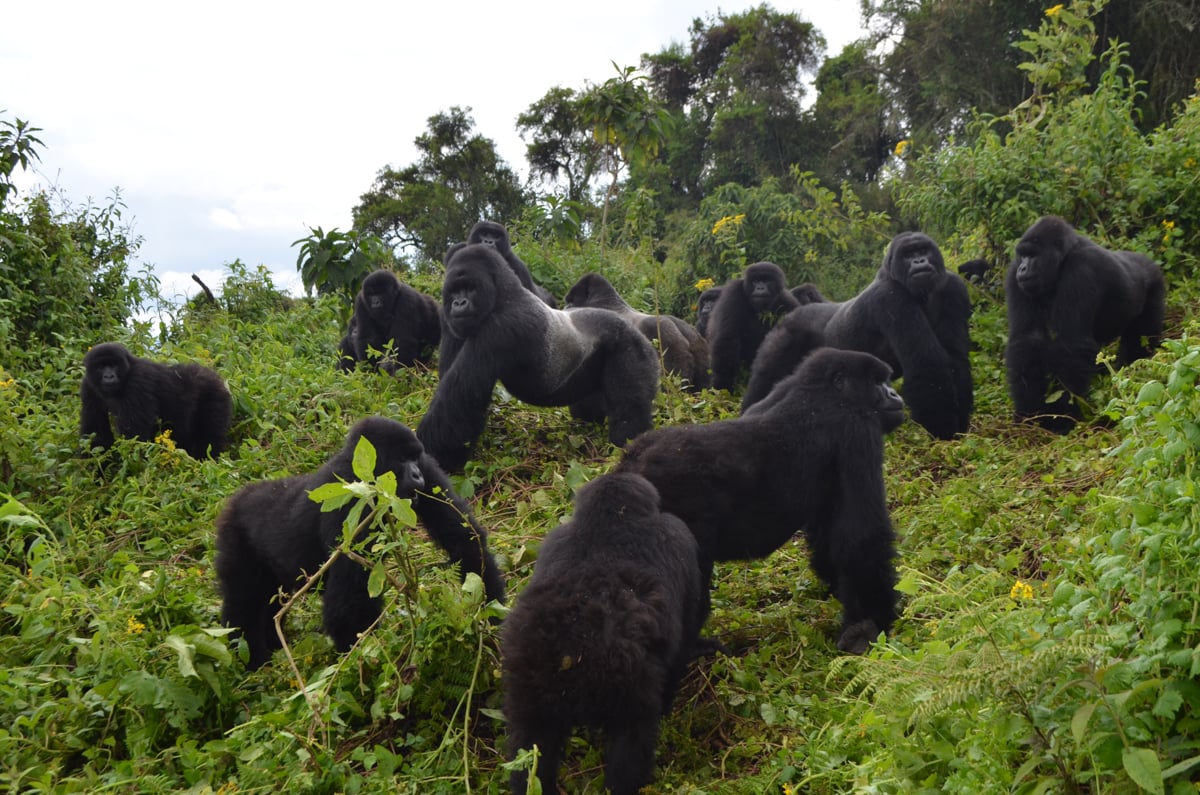
Mountain gorillas live in stable family groups of 5–30 individuals, led by a dominant silverback gorilla. The silverback protects the group, makes decisions on movement, and mediates conflicts. Females and offspring form the core, with younger males (blackbacks) assisting.
They are peaceful, with aggression rare except in defense. Communication includes vocalizations (grunts, hoots), facial expressions, and dramatic chest-beating displays by silverbacks to assert dominance or ward off threats.
Groups build fresh nests daily from vegetation for sleeping—each gorilla constructs its own.
Mountain Gorilla Strength
How strong is a mountain gorilla? Silverbacks possess extraordinary power, with estimates suggesting they are 4–10 times stronger than an average human in upper-body strength, pound-for-pound.
Their robust muscles, dense bones (three times thicker and stronger than human bones), and leverage allow feats like bending vegetation or lifting heavy objects.
Real-life examples include silverbacks uprooting saplings or charging through dense undergrowth effortlessly. While not aggressive toward humans in habituated groups, their strength underscores why respect and distance are essential during encounters.
Mountain Gorilla Habitat & Environment
Mountain gorilla habitat consists of high-altitude montane and bamboo forests with cool, misty climates. Dense vegetation provides food and cover, while volcanic fasoils support diverse plants. Elevations create cooler temperatures (often below freezing at night), explaining their thick fur.
These isolated pockets are surrounded by human settlements, making habitat protection critical.
Conservation Status & Why Are Mountain Gorillas Endangered?
Mountain gorillas are classified as endangered by the IUCN (downgraded from critically endangered in 2018 due to population growth). The current mountain gorilla population is approximately 1,063 individuals (as of recent estimates from censuses in Virunga ~604 and Bwindi-Sarambwe ~459).
Why are mountain gorillas endangered? Primary threats include:
- Habitat loss and fragmentation from agriculture, logging, and settlement.
- Poaching (for bushmeat, trophies, or snares set for other animals).
- Disease transmission from humans.
- Political instability and human-wildlife conflict.
How many mountain gorillas are left? Around 1,063, a remarkable increase from fewer than 400 in the 1980s, thanks to anti-poaching patrols, community involvement, and tourism revenue.
Organizations like the World Wildlife Fund (WWF), Dian Fossey Gorilla Fund, and International Gorilla Conservation Programme lead efforts.
Gorilla Trekking: Experience the Magic in the Wild
Gorilla trekking Uganda (and Rwanda) offers an ethical way to observe these primates. Habituation allows close, peaceful encounters with family groups.
The experience: A guided trek through misty forests, following trackers to locate a group. Spend one magical hour with the gorillas—watching them feed, play, and interact.
Permits are required (limited daily to minimize impact). In Uganda, Bwindi Impenetrable National Park is premier, with multiple habituated groups.
Ready for an adventure? Book a gorilla safari with All Uganda Safari Tours for expert-guided, responsible treks. Contact us today or visit our site for Uganda gorilla trekking packages, often combined with chimpanzee trekking or full Uganda safari packages.
Best Time to See Mountain Gorillas
Gorilla trekking is possible year-round, as gorillas don’t migrate seasonally. The best time is during dry seasons: June–September and December–February. Trails are drier, visibility better, and temperatures more comfortable (though rain can occur anytime).
Peak dry months offer clearer photos and easier hikes, but book permits early.
Interesting Mountain Gorilla Facts
- Share ~98% DNA with humans.
- Build new nests every night.
- Each has unique nose prints (like human fingerprints) for identification.
- Silverbacks can live 35–50 years.
- Infants ride on mothers’ backs for 3–4 years.
- They are the only great ape population known to be increasing.
FAQs about a Mountain gorilla
Where do mountain gorillas live?
Exclusively in the Virunga Massif (Rwanda, Uganda, DRC) and Bwindi Impenetrable National Park (Uganda).
How many mountain gorillas are left?
Approximately 1,063 in the wild.
Are mountain gorillas dangerous?
No—they are gentle and peaceful unless threatened. Habituated groups tolerate human presence calmly.
How strong is a mountain gorilla?
Several times stronger than a human, with powerful builds for defense and daily tasks.
Can tourists visit mountain gorillas?
Yes, through regulated gorilla trekking in protected parks. Permits and guided tours ensure safety and conservation.
Is a mountain gorilla the biggest gorilla?
No, but they are the largest eastern gorilla subspecies.
Mountain gorilla discovery?
First described in 1902 by German captain Robert von Beringe in the Virungas.
Explore more: Check our gorilla trekking safaris, chimpanzee trekking, or Uganda safari packages for your next adventure.