
Unmatched Silverback Gorilla Strength: 10× Stronger Than Any Human
Discover the awe-inspiring silverback gorilla strength: up to 4–10 times stronger than an average human, with the power to lift over 1,800 lbs, a bite force of ~1,300 PSI, and unmatched upper-body muscle.
Explore gorilla strength vs human comparisons, real-life uses of their power, diet, habitat in Uganda’s Bwindi and Volcanoes National Parks, plus gorilla trekking tips. Learn why these gentle giants rule the primate world.
How Strong Is a Silverback Gorilla?
How strong is a silverback gorilla? Scientific estimates and field observations consistently place a mature male silverback at 4 to 10 times stronger than an average adult human in upper-body strength and pulling power. This isn’t hype—it’s rooted in their unique muscle physiology, bone density, and leverage.
A silverback can exert pulling forces exceeding 1,800 pounds (about 816 kg) in deadlift-style motions, compared to a well-trained human strongman’s typical maximum of 300–500 pounds.
Some reliable sources, including wildlife records from Virunga National Park, document a silverback gorilla lifting or dragging over 1,763 pounds (800 kg) of dead weight—roughly twice what the world’s top human weightlifters achieve in competition.
In hypothetical bench-press equivalents, estimates reach as high as 4,000 pounds, though real-world measurements focus more on functional strength like uprooting trees or bending thick bamboo.
This male gorilla power stems from dense, fast-twitch muscle fibers optimized for explosive bursts rather than long-endurance activities. Their arms, shoulders, and chest form a powerhouse capable of delivering blows with 1,300–2,700 pounds of force.
In the wild, observers have witnessed silverbacks effortlessly snapping branches the thickness of a human thigh or tossing heavy logs aside while foraging.
Silverback gorilla strength manifests in everyday tasks that would exhaust multiple humans. One silverback can clear a path through dense undergrowth that a team of loggers might struggle with. This raw power earns them respect across the primate world, making them the ultimate forest guardians.
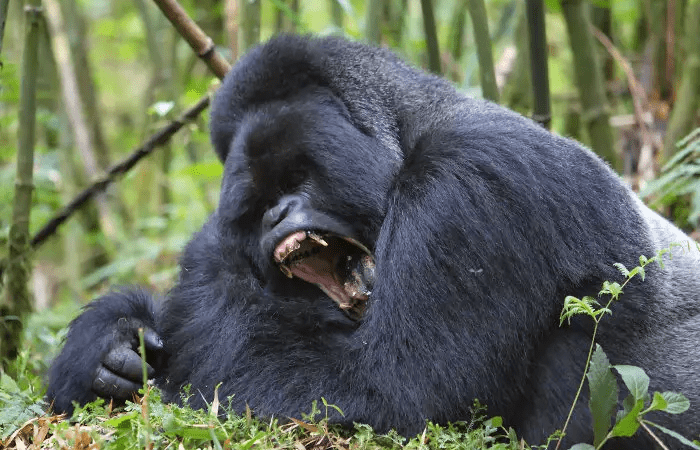
About a silverback gorilla
A silverback gorilla is the undisputed leader of a gorilla family troop, instantly recognizable by the striking patch of silver-gray hair that develops across its back and hips once it reaches full maturity around age 12–15.
These majestic males are the dominant figures in mountain gorilla societies, guiding, protecting, and defending their groups from threats.
Among the great apes, they rank as one of the strongest primates alive today, with muscle power that far surpasses most other animals in their ecosystem.
Mountain gorillas (Gorilla beringei beringei), the species most famous for silverback leadership, thrive in the high-altitude forests of Central Africa. The silverback’s role extends far beyond mere size—he resolves conflicts within the troop, leads foraging expeditions, and stands as the primary defender against predators or rival males.
His presence ensures the safety and cohesion of up to 30 individuals, including females, infants, and younger blackback males.
What makes silverback gorilla strength so legendary? It’s not just brute force; it’s the combination of massive muscle mass, powerful jaws, and evolutionary adaptations honed over millions of years for life in dense, rugged forests.
Visitors on gorilla trekking safaris often describe the heart-stopping moment when a silverback charges or chest-beats—a display of male gorilla power that echoes through the canopy.
Yet despite their immense capabilities, silverbacks are generally peaceful herbivores, using their strength wisely rather than aggressively. This balance of power and serenity draws thousands of eco-tourists to Uganda’s Bwindi Impenetrable National Park and Mgahinga Gorilla National Park each year, supporting vital conservation efforts.
Silverback Gorilla Weight and Body Structure
An adult male mountain gorilla silverback typically weighs between 136 and 220 kg (300–485 pounds), with many reaching around 195 kg (430 pounds) in prime condition.
That’s 2–3 times the weight of an average human male. Their standing height reaches 1.5–1.8 meters (5–6 feet), but their arm span stretches up to 2.6 meters—giving incredible reach and leverage.
The body structure fueling silverback gorilla strength is a masterpiece of evolutionary engineering:
- Muscle mass: They possess 1.5–2 times more muscle relative to body size than humans, concentrated in the upper body, back, and arms.
- Arm length and power: Long, powerful arms (longer than their legs) allow superior pulling and climbing force.
- Bone density: Thicker, denser bones support immense loads without fracture.
- Chest and shoulders: Barrel-shaped torsos house enormous pectoral and deltoid muscles for chest-beating displays and defensive charges.
These features make silverbacks perfectly adapted for knuckle-walking on all fours while carrying their massive frames through steep mountain terrain. Their skeletal frame distributes weight efficiently, and their grip strength can crush thick vegetation or, in rare defensive moments, overpower threats.
This physique explains why how much can a gorilla lift questions yield such staggering answers—often 10 times their body weight in functional tasks.
Gorilla Bite Force
When discussing silverback gorilla strength, bite force deserves special attention. People searching “gorilla bite force” discover that silverbacks possess one of the most powerful jaws in the primate kingdom, estimated at around 1,300 PSI (pounds per square inch). This is nearly double the bite force of a lion (650–1,000 PSI) and vastly exceeds a human’s 162 PSI average.
Powerful jaw muscles combined with large canine teeth (up to 5 cm long) create this crushing capability. Silverbacks use their bite primarily for processing tough vegetation—stripping bark, cracking hard nuts, or chewing fibrous stems—but it also serves as a last-resort defensive weapon. The canines deliver deep puncture wounds, while the molars grind with immense pressure.
Unlike measured big-cat bites, gorilla bite force remains an estimate derived from skull measurements, muscle cross-sections, and computer modeling.
Still, 1,300 PSI ranks among the highest in primates, underscoring the silverback’s complete dominance in close-quarters encounters. This jaw power complements their overall male gorilla power, making them formidable protectors.
Silverback Gorilla Strength vs Human Strength
Comparisons always rank high in searches for gorilla strength vs human. Here’s a clear breakdown:
|
Feature |
Silverback Gorilla |
Average Human (Adult Male) |
|
Strength |
4–10× stronger (upper body) |
Baseline |
|
Weight |
Up to 220 kg (485 lbs) |
70–90 kg (154–198 lbs) |
|
Bite Force |
~1,300 PSI |
162 PSI |
|
Lift Capacity |
800–1,800+ kg (1,763–4,000 lbs) |
150–400 kg (deadlift max) |
|
Muscle Mass |
1.5–2× more relative to body size |
Standard |
|
Arm Span |
Up to 2.6 m |
~1.7–1.8 m |
A silverback could theoretically overpower 6–10 average humans in raw pulling or lifting contests. Their thicker bones resist breakage, and their fast-twitch fibers deliver explosive power that humans’ endurance-focused muscles can’t match.
While elite strongmen like Eddie Hall push human limits, even they fall short of silverback capabilities in sustained forest tasks. Hypothetical matchups always favor the gorilla due to size, reach, and jaw power—though real silverbacks rarely engage in unnecessary conflict.
What Silverback Gorillas Use Their Strength For
Silverback gorilla strength serves practical, life-sustaining purposes rather than random displays of dominance. Primary uses include:
- Defending the gorilla group: The silverback charges, chest-beats, or physically intervenes against leopards, rival males, or human intruders. His presence alone deters most threats.
- Foraging and breaking branches for food: He uproots bamboo, bends thick stalks, or strips bark to access nutrient-rich cores—tasks impossible for lighter troop members.
- Climbing and moving through forest: Despite their size, silverbacks scale trees and navigate steep volcanic slopes using arm strength for knuckle-walking and brachiation support.
- Protecting family from threats: They carry infants during emergencies, clear paths, and maintain troop hierarchy through controlled displays rather than constant fighting.
These applications highlight intelligent use of power. Chest-beating, for instance, produces a resonant sound audible over a kilometer, warning rivals without physical contact—saving energy while asserting male gorilla power.
Habitat of Silverback Gorillas
Silverbacks inhabit the misty, high-altitude cloud forests of the Virunga Mountains region. Mountain gorillas specifically thrive in:
- Bwindi Impenetrable National Park (Uganda) – Home to over half the world’s mountain gorillas in dense, ancient rainforest.
- Mgahinga Gorilla National Park (Uganda) – Smaller but critical habitat overlapping Rwanda and DRC borders.
- Volcanoes National Park (Rwanda) – Iconic slopes where Dian Fossey conducted groundbreaking research.
- Virunga National Park (DRC) – Shared volcanic landscape supporting habituated families.
These protected areas feature bamboo zones, montane forests, and alpine meadows at 2,200–4,300 meters elevation. The rugged terrain demands the very silverback gorilla strength we admire—powerful arms for climbing slippery slopes and breaking through vegetation. Uganda’s parks, in particular, offer the best-accessible experiences for visitors seeking authentic encounters.
Diet and Strength
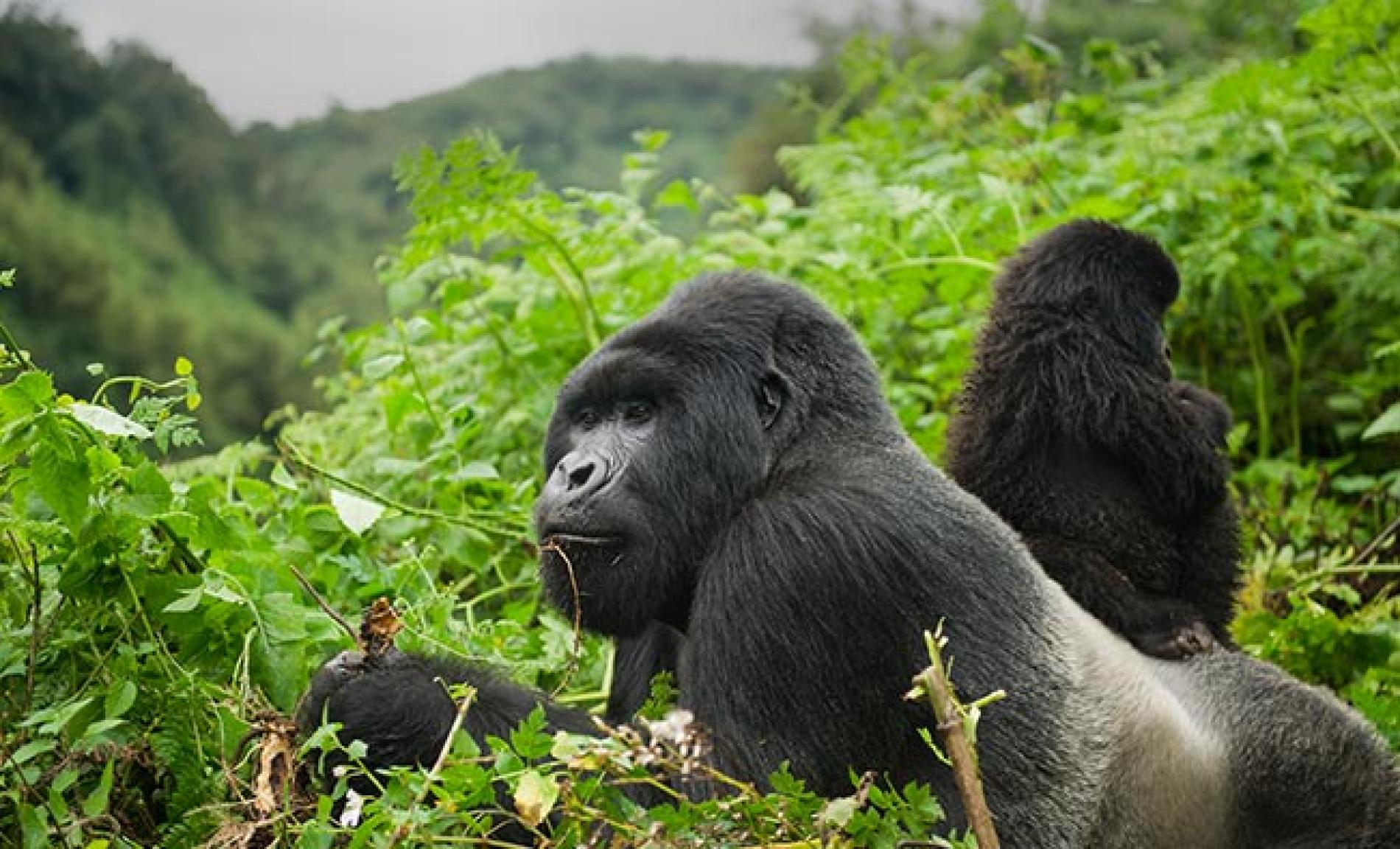
A silverback’s plant-powered diet directly fuels its legendary muscle. As herbivores, they consume 18–34 kg (40–75 pounds) of vegetation daily—equivalent to 30+ kg in peak seasons. Key foods include:
- Leaves, shoots, and stems (majority of intake)
- Bamboo shoots (favorite in Uganda’s parks)
- Fruits, bark, flowers, and roots
- Occasional insects or larvae for protein
This high-volume, fiber-rich intake provides sustained energy without heavy meat reliance. Efficient digestive systems extract maximum nutrients, supporting massive muscle maintenance.
The diet explains how silverbacks sustain how much can a gorilla lift feats daily—constant foraging builds and maintains the strength needed for leadership.
Interesting Facts About Silverback Gorillas
- A silverback leads troops of up to 30 gorillas, making life-or-death decisions for the entire family.
- They communicate via over 20 vocalizations, plus dramatic chest-beating displays that can last 30 seconds.
- Despite immense silverback gorilla strength, they are mostly peaceful—over 90% of interactions remain non-violent.
- Silverbacks can live 35–50 years in the wild, reaching peak strength between 15–25 years.
- They practice “infant carrying” and grooming to strengthen family bonds.
- One famous silverback in Virunga felled trees to create forest clearings, acting as a keystone species.
- Young males (blackbacks) aspire to become silverbacks, sometimes forming alliances before challenging for dominance.
Gorilla Conservation
Mountain gorillas remain endangered, with only about 1,000 individuals left. Dedicated efforts by the Uganda Wildlife Authority (UWA), World Wildlife Fund (WWF), and the International Gorilla Conservation Programme have driven population growth from under 300 in the 1980s to current levels.
Anti-poaching patrols, habitat restoration, and community education form the backbone. Critically, gorilla trekking tourism generates millions annually—funds that directly support ranger salaries, veterinary care, and local schools.
In Uganda, permit fees help communities around Bwindi and Mgahinga, reducing human-wildlife conflict and incentivizing protection. Sustainable tourism proves that witnessing silverback gorilla strength in the wild actively saves the species.
Where Tourists Can See Silverback Gorillas in the Wild
Experience silverback gorilla strength up close in Uganda’s premier parks. Bwindi Impenetrable National Park offers 17 habituated gorilla families across multiple sectors, with daily trekking permits allowing one-hour encounters. Mgahinga Gorilla National Park features the Nyakagezi family—known for multiple silverbacks—amid stunning volcanic scenery.
Book through trusted operators like Nature Safaris Africa for expert guides, safe tracking, and seamless logistics. Permits cost $800 (foreign non-residents) and sell out months ahead—reserve early.
Combine with chimpanzee tracking or cultural visits for the ultimate Uganda safari. Standing mere meters from a chest-beating silverback remains the pinnacle of wildlife tourism.
FAQs about Silverback Gorilla Strength
How strong is a silverback gorilla?
Estimates show 4–10 times stronger than an average human, with lifting capacity up to 1,800+ pounds.
How much can a gorilla lift?
Silverbacks routinely handle 800–1,800 kg in functional tasks—far beyond human records.
Are gorillas stronger than humans?
Yes—dramatically so in upper-body power, bite force, and overall muscle density.
Can a gorilla beat a lion?
In most hypothetical scenarios, the silverback’s strength, bite, and agility give it the edge, though natural encounters are extremely rare.
What is the bite force of a gorilla?
Approximately 1,300 PSI—powerful enough to process tough vegetation or defend effectively.
Silverback gorilla weight?
Up to 220 kg, with typical adults around 195 kg.
Conclusion
From their towering physique and 1,300 PSI bite to their role as gentle forest kings, silverback gorilla strength continues to captivate and inspire. These magnificent animals remind us of nature’s raw power balanced with profound intelligence and family loyalty.
Whether exploring gorilla strength vs human limits or planning your next adventure, one truth stands clear: nothing compares to witnessing male gorilla power in the wild.
Ready to meet a silverback? Contact us today for personalized gorilla trekking packages in Bwindi or Mgahinga. Book your encounter with the King of Primates and contribute directly to their conservation. The forests await—where silverback gorilla strength comes alive in its natural glory.