
THE WATTLED JACANA: Species Overview, Behavior, Habitat,
& East African Birdwatching Opportunities
Introduction: What Is the Wattled Jacana?
The Wattled Jacana (Jacana jacana) is one of the most visually striking and behaviorally fascinating waterbirds found across tropical and subtropical wetlands.
Known globally for its extraordinary ability to walk across floating vegetation on lily pads and water hyacinths, this bird has earned the popular nickname “Jesus bird” or “lily trotter.”
Its bold coloration, unusual social behavior, and dramatic wattles make it a favorite subject among birdwatchers, wildlife photographers, and ecotourists traveling to East Africa and South America.
For visitors on safari in Uganda, Rwanda, Tanzania, Kenya, or other East African destinations, encountering the Wattled Jacana at the water’s edge is a highlight that no bird checklist should be without.
This guide covers everything you need to know about this remarkable species — from its taxonomy and anatomy to its feeding habits, breeding behavior, conservation status, and the best places in East Africa to see it.
Wattled Jacana Taxonomy & Classification
Understanding where the Wattled Jacana fits in the broader classification of birds helps birders appreciate its evolutionary uniqueness.
- Kingdom: Animalia
- Phylum: Chordata
- Class: Aves (Birds)
- Order: Charadriiformes (Shorebirds and allies)
- Family: Jacanidae (Jacanas)
- Genus: Jacana
- Species: Jacana jacana
The family Jacanidae contains eight recognized species worldwide, distributed across Africa, Asia, Australia, and the Americas. The Wattled Jacana is primarily a New World species native to Central and South America, but it is closely related to the African Jacana (Actophilornis africanus), which is the species most commonly encountered during East African safaris.
Both species share nearly all the remarkable traits — oversized feet, polyandrous breeding systems, and wattle adornments — that make jacanas so scientifically interesting.
In East Africa, when birders and guides refer to “jacanas,” they most commonly mean the African Jacana. This guide covers both species where relevant, giving travelers from the USA, Canada, and the UK a full picture of the jacana family they are likely to encounter in the wild.
Physical Description and Identification
Size and Build
Jacanas are medium-sized waterbirds, typically measuring between 23 and 30 centimeters in length (9 to 12 inches). They have long legs and disproportionately long toes and claws — the primary adaptation that allows them to spread their weight across floating aquatic vegetation. The wingspan ranges from approximately 40 to 50 centimeters.
Plumage and Coloration
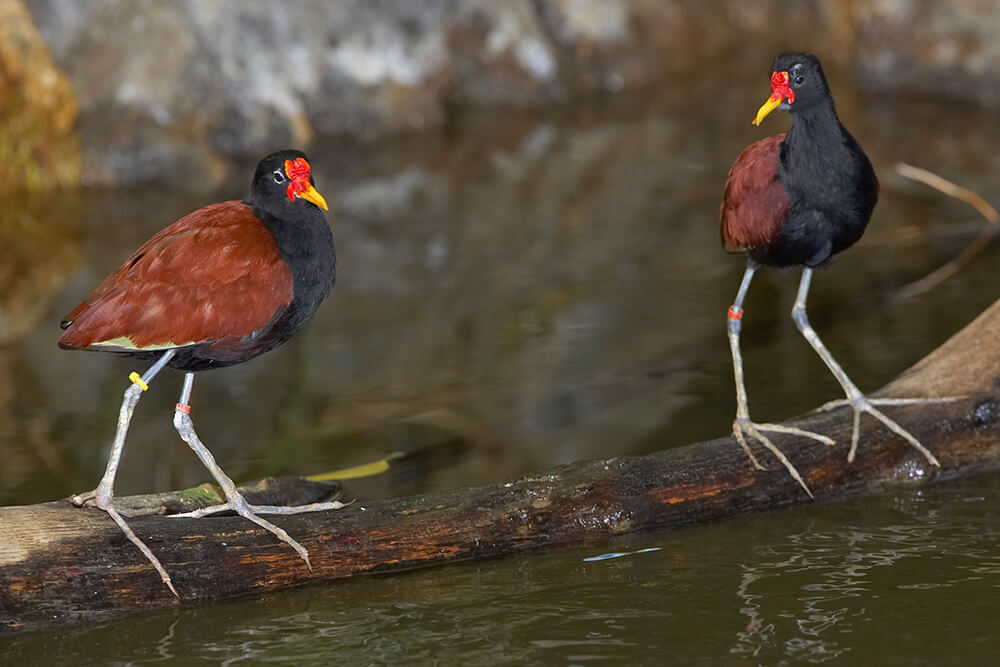
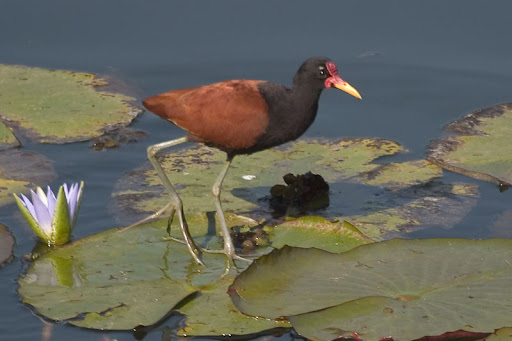
The Wattled Jacana has a striking and unmistakable appearance. Adults display rich chestnut-brown upperparts and a glossy black head, neck, and breast. The wings show a conspicuous yellow-green flight feather panel that flashes brilliantly during flight — one of the most dazzling sights in African and South American wetlands. The underparts are darker chestnut.
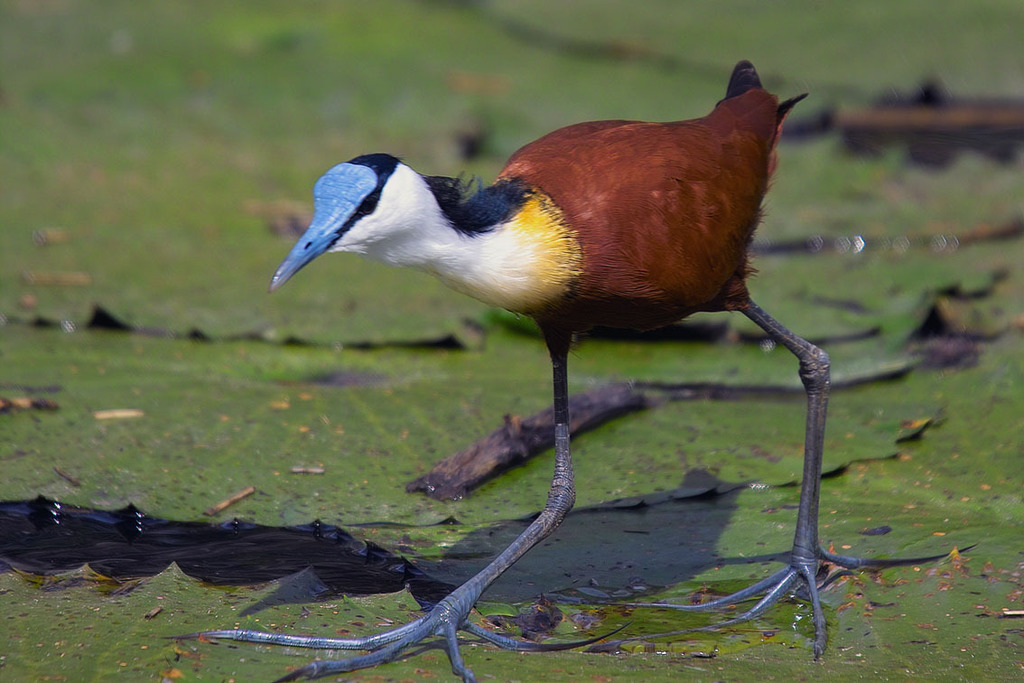
The African Jacana, seen widely during East African safaris, has a very similar and equally eye-catching pattern: a chestnut body, a blue frontal shield and bill, and a contrasting black and white head and neck. Both species have a spine (a tiny spur) on the bend of each wing, used in territorial and parental defense.
Wattles and Facial Ornamentation
The name ‘wattled’ refers to the fleshy, brightly colored lobe of skin — the wattle — that hangs from the base of the bill. In the Wattled Jacana, this structure is red or yellow and becomes more pronounced and vividly colored in breeding adults.
In the African Jacana, a blue frontal shield replaces this ornamentation. These structures are thought to play a role in mate attraction and individual recognition.
Feet and Toes: The Lily-Walker Adaptation
Perhaps the most remarkable feature of any jacana is its feet. The toes are enormously elongated — in some individuals, the combined span of the toes can exceed the length of the bird’s body.
This extraordinary adaptation distributes the bird’s weight so efficiently across floating plants that it can walk with ease on lily pads, hyacinth mats, and other aquatic vegetation without sinking. This is the behavior that earns jacanas the “Jesus bird” nickname among safari-goers and locals alike.
Juvenile Plumage
Juvenile jacanas are strikingly different from adults. Young birds are brown above with a white supercilium (eyebrow stripe) and white underparts.
The facial shield or wattle is much less developed. Juveniles acquire adult plumage gradually over their first year, making age identification an interesting challenge for birders.
Habitat: Where Do Wattled Jacanas Live?
Jacanas are birds of freshwater wetlands. They inhabit a variety of aquatic environments, always choosing areas with abundant floating or emergent vegetation.
Preferred Habitat Types
- Shallow lakes and lakeshores with lily pads
- Swamps and marshes with dense floating vegetation
- Slow-moving rivers and floodplains
- Seasonal floodplains and oxbow lakes
- Rice paddies and agricultural wetlands
- Papyrus swamps and reed beds
Jacanas are not found in open water without vegetation. The floating plant surface is both their foraging ground and their nesting platform. Without lily pads, water hyacinth, or similar plants, jacanas cannot survive.
Habitat in East Africa
In East Africa, jacanas are abundant wherever suitable wetland habitat exists. Lake Victoria — the largest lake in Africa and the world’s second-largest freshwater lake — hosts large populations of African Jacanas.
The Nile delta areas of Uganda, the vast wetlands of the Okavango Delta, and the shallow lakes of the East African Rift Valley are all excellent jacana habitat.
Uganda in particular offers some of the finest jacana viewing on the continent. Lake Mburo National Park, Murchison Falls National Park, Queen Elizabeth National Park, and the wetlands surrounding Lake Victoria all harbor healthy jacana populations year-round. The Kazinga Channel between Lakes Edward and George is especially renowned among birders visiting Uganda.
Geographic Range and Distribution
Wattled Jacana — New World Distribution
The Wattled Jacana (Jacana jacana) is native to the Americas, ranging from Panama and Trinidad south through most of tropical South America. It is commonly seen in Brazil, Venezuela, Colombia, Ecuador, Peru, Bolivia, Paraguay, and Argentina. It is a common bird of the Amazon basin and the Pantanal — the world’s largest tropical wetland.
African Jacana — East Africa Distribution
The African Jacana (Actophilornis africanus) is the jacana of East Africa and is the species most relevant to safari travelers visiting Uganda, Kenya, Tanzania, Rwanda, and Ethiopia. It ranges across sub-Saharan Africa wherever suitable wetlands exist. Key East African countries with strong populations include:
- Uganda: Lake Victoria shoreline, Lake Mburo, Murchison Falls, Queen Elizabeth NP
- Kenya: Lake Naivasha, Lake Victoria, Masai Mara floodplains
- Tanzania: Serengeti floodplains, Selous, Lake Manyara
- Rwanda: Akagera National Park wetlands
- Ethiopia: Lake Tana, Awash River
Behavior and Ecology
Feeding Behavior
Jacanas are omnivores. They forage by walking slowly across floating vegetation, picking invertebrates, seeds, and small fish from the water’s surface and from beneath floating leaves.
They regularly lift lily pads with their bills or feet to expose the aquatic insects, snails, and crustaceans hiding underneath — a feeding technique unique to the family.
Common prey items include insects and their larvae, small mollusks, crustaceans, spiders, small fish, and the seeds of aquatic plants. Jacanas spend most of their daylight hours feeding, moving steadily across vegetation mats in search of food.
The “Jesus Bird” Walk
The sight of a jacana walking confidently across lily pads, seemingly on the water’s surface, is one of the most magical spectacles in African birdwatching.
The bird’s enormously elongated toes spread its body weight over a large surface area, making it possible to walk on plants that would sink under the weight of most birds. When the vegetation does sink slightly, jacanas move quickly and nimbly to the next stable patch.
Polyandry: The Jacana’s Remarkable Breeding System
wattled jacana male vs female
Perhaps the most scientifically fascinating aspect of jacana behavior is their breeding system. Jacanas practice polyandry — a system in which females mate with multiple males and the males undertake most or all of the parenting duties. This is the reverse of the arrangement seen in most bird species.
Female jacanas are larger than males (a condition called reverse sexual dimorphism) and are highly territorial. A single female may control a territory that encompasses the smaller territories of two to four males. She will mate with all of them and lay clutches of eggs in their respective nests.
The male then incubates the eggs and raises the chicks almost entirely on his own, while the female defends the overall territory and may mate with additional males.
Chick Brooding: Tucked Under the Wings
Jacana males exhibit one of the most charming parenting behaviors in the bird world. When danger threatens, the male gathers his chicks and tucks them under his wings for protection — with only the tiny legs of the chicks visible dangling below his body.
This behavior makes the adult bird appear to have four or six extra legs, confusing many first-time observers. It is a remarkable sight and a frequent highlight of safari wetland walks.
Territorial Behavior
Both male and female jacanas are highly territorial and will aggressively defend their areas against intruders of the same species. They are noisy birds, producing loud, rattling, and cackling calls that carry across open water. Wing spurs are used in disputes, and confrontations can be fierce, though they rarely result in serious injury.
Flight
Despite appearing sedentary when walking on vegetation, jacanas are strong and direct fliers. In flight, the yellow-green wing panels of the Wattled Jacana and the similar panels of the African Jacana create a spectacular flash of color. Jacanas typically fly low over water with rapid wingbeats. They may be reluctant to take flight when approached but will do so quickly if pressed.
Breeding and Reproduction
Nesting
Jacana nests are simple, shallow platforms of aquatic vegetation built directly on floating plants or on partly submerged vegetation.
The nest is often anchored loosely to surrounding plants but can drift with currents and wind. Because the nests are built on unstable floating surfaces, the male must occasionally reposition or rebuild the nest during incubation.
Eggs
A typical jacana clutch consists of four eggs. Jacana eggs are among the most striking in the bird world — glossy, heavily marked with irregular dark brown and black scrawl lines on a pale background.
These bold markings may serve as camouflage against the patterned vegetation of the nest. Incubation lasts approximately 22 to 28 days.
Chick Development
Jacana chicks are precocial, meaning they are mobile and can walk and swim very shortly after hatching. They grow quickly and are capable of short flights within 5 to 6 weeks.
The male continues to brood and protect chicks for several weeks after hatching, using the wing-tucking behavior described above.
Breeding Season in East Africa
In East Africa, jacana breeding is linked to water levels and vegetation cycles rather than strict seasonal patterns. Breeding can occur throughout the year in areas with stable wetland conditions, but peaks are often associated with the long rains (March to May) and post-rain periods when aquatic vegetation is abundant.
Vocalizations and Calls
Jacanas are vocal birds, and their calls are an important identification feature. The most commonly heard vocalization is a loud, rapid, rattling or clattering call — often described as sounding like a mechanical alarm or a string of hard, sharp notes. This call is used in territorial disputes, between mates, and as an alarm when predators are detected.
Additional vocalizations include softer clucking notes used during courtship and between adults and chicks. The alarm call of the jacana often alerts other waterbirds in the area to the presence of a predator, making jacanas useful sentinel species for wildlife photographers and guides.
Conservation Status
Both the Wattled Jacana and the African Jacana are currently listed as Least Concern by the International Union for Conservation of Nature (IUCN). Their populations are believed to be stable and even expanding in some regions, particularly where wetland habitats remain intact.
Threats
Despite their currently stable status, jacanas face several ongoing threats:
- Wetland drainage and conversion for agriculture — the single greatest threat to jacana habitat globally
- Pollution of freshwater systems from agricultural runoff, sewage, and industrial waste
- Introduction of invasive plants that alter wetland vegetation structure
- Hunting pressure in some regions
- Climate change-driven alterations to rainfall patterns and seasonal flooding cycles
In East Africa, the health of jacana populations is closely tied to the health of major wetland systems like Lake Victoria, Lake Mburo, and the Nile basin wetlands. Conservation of these systems benefits not only jacanas but the hundreds of other waterbird species that depend on them.
Conservation in Uganda
Uganda has made significant conservation investments in its wetland systems. The country’s national parks and wildlife reserves protect large areas of high-quality jacana habitat.
Birding tourism — including visits from US, Canadian, and European travelers — provides economic incentives for continued wetland conservation.
Responsible safari operators play a critical role in this ecosystem by connecting visitors with wildlife in ways that generate conservation revenue and community benefit.
Seeing Jacanas on an East African Safari
Best Locations in Uganda
Uganda is one of the finest birding destinations in the world, with over 1,060 recorded bird species — more than in all of North America. For jacana viewing specifically, these sites stand out:
- Lake Mburo National Park: The lake and its papyrus-fringed shores host African Jacanas year-round. This compact park is ideal for birding walks along the water’s edge.
- Queen Elizabeth National Park: The Kazinga Channel cruise is one of East Africa’s premier wildlife experiences and regularly produces excellent jacana sightings alongside hippos, elephants, and hundreds of other bird species.
- Murchison Falls National Park: The Nile delta area and Lake Albert shores offer outstanding wetland birding with jacanas among the highlights.
- Lake Victoria Shoreline: Multiple access points around Entebbe and nearby areas produce reliable jacana sightings.
- Bigodi Wetland Sanctuary: Adjacent to Kibale National Park, this community-managed wetland is a superb birding site often combined with chimpanzee tracking.
Best Locations in Kenya and Tanzania
- Lake Naivasha, Kenya: One of the most productive freshwater lakes in East Africa for waterbirds, with large jacana populations on the lily pads.
- Masai Mara floodplains, Kenya: Seasonal wetlands produce excellent waterbird sightings including jacanas.
- Lake Manyara National Park, Tanzania: Famous for its waterbirds including jacanas, flamingos, and pelicans.
- Selous Game Reserve, Tanzania: Riverine and lake habitats support strong jacana populations.
Tips for Spotting and Photographing Jacanas
- Time your visits for early morning (6:00–9:00 AM) when birds are most active and light is ideal for photography.
- Use a boat or canoe where possible — approaching from the water minimizes disturbance.
- Watch for the characteristic walking-on-water behavior on lily pads from a quiet, stable vantage point.
- Listen for the loud rattling call — jacanas often announce their presence before they are seen.
- During the breeding season, watch for males with chick legs visible beneath their wings — a truly unforgettable sight.
- Bring a 400mm or 500mm telephoto lens for frame-filling shots without disturbing the birds.
Quick Reference: Wattled Jacana and African Jacana Facts
Scientific name (Wattled): Jacana jacana
Scientific name (African): Actophilornis africanus
Family: Jacanidae
Length: 23–30 cm (9–12 inches)
Weight: 75–170 g
Wingspan: 40–53 cm
Lifespan: Estimated 5–10 years in the wild
Diet: Omnivore — insects, mollusks, seeds, small fish
Breeding system: Polyandrous (female mates with multiple males)
Incubation: 22–28 days
Clutch size: 4 eggs
Conservation status: Least Concern (IUCN)
Nickname: Jesus bird, lily trotter
Best viewing: Uganda, Kenya, Tanzania, Rwanda
FAQs About the Wattled Jacana
Why is the jacana called the ‘Jesus bird’?
The jacana’s enormously elongated toes allow it to walk across floating lily pads and water hyacinth, appearing to walk on the surface of the water.
This remarkable adaptation has earned it the popular nickname ‘Jesus bird’ or ‘lily trotter.’ The bird is not literally walking on water — it is distributing its weight across floating vegetation — but the visual effect is stunning and the nickname has stuck.
Are jacanas dangerous?
Jacanas are not dangerous to humans. They are small birds and pose no threat to people. They do have a small wing spur used in territorial disputes with other jacanas, but this is never directed at humans. They may be noisy and defensive if approached closely during the breeding season.
What is the difference between the Wattled Jacana and the African Jacana?
The Wattled Jacana (Jacana jacana) is native to Central and South America and features a red or yellow wattle at the base of the bill. The African Jacana (Actophilornis africanus) is native to sub-Saharan Africa and has a distinctive blue frontal shield and bill.
Both species share similar ecology, behavior, and the remarkable foot structure. East Africa safari visitors will encounter the African Jacana.
Can I see jacanas in Uganda?
Yes — Uganda is one of the best countries in the world for seeing African Jacanas. Major national parks including Murchison Falls, Queen Elizabeth, and Lake Mburo all offer excellent jacana habitat.
The Kazinga Channel boat cruise is particularly famous for waterbird encounters including jacanas. Uganda’s wetlands are among the most biodiverse in Africa, and any birding safari there should include jacana watching.
Do jacanas migrate?
Jacanas are generally non-migratory. Most populations are resident year-round in their territories, moving locally within wetland systems in response to water level changes.
In East Africa, birds at some sites may move seasonally in response to rainfall patterns, but true long-distance migration is not a characteristic of this family.
Plan Your East African Safari with us today!
The Wattled Jacana and its East African cousin, the African Jacana, represent everything that makes East African birdwatching so extraordinary: spectacular plumage, astonishing behavioral adaptations, and access to some of the most pristine wetland habitats left on Earth.
Watching a jacana walk effortlessly across a lily pad on the shores of Lake Mburo or the Kazinga Channel is one of those safari moments that stays with you for life.
If you are planning a birdwatching safari to East Africa — or combining birding with gorilla trekking, chimpanzee tracking, or classic big-game safari experiences — Uganda is the destination that delivers it all under one remarkable roof.
Why Choose us?
We are a Uganda-based safari operator specializing in East African wildlife safaris with deep expertise in gorilla trekking, chimpanzee tracking, and birdwatching tours across Uganda, Rwanda, Kenya, and Tanzania. Here is why travelers from the USA, Canada, the UK, Australia, and beyond trust us with their safari dreams:
- Local expertise: We are based in Uganda. Our guides, drivers, and naturalists know the forests, wetlands, and savannahs of East Africa intimately. We know exactly where the jacanas nest on the Kazinga Channel and exactly where to find mountain gorillas in Bwindi Impenetrable Forest.
- Gorilla trekking specialists: All Uganda Safari Tours is your gateway to mountain gorilla encounters in Bwindi Impenetrable National Park and Mgahinga Gorilla National Park — two of the most breathtaking wildlife experiences on the planet. We handle all permit bookings, logistics, and expert guiding.
- Birdwatching safaris: Uganda hosts over 1,060 bird species. We design dedicated birding itineraries for listers, photographers, and casual enthusiasts, incorporating the country’s finest wetland, forest, and savannah habitats.
- Comprehensive East Africa packages: From Uganda’s gorillas and chimpanzees to Kenya’s Masai Mara lion prides and Tanzania’s Serengeti wildebeest migration, we design multi-country itineraries tailored to your interests, schedule, and budget.
- Responsible tourism: We are committed to conservation, community benefit, and low-impact travel. Every booking with us supports local communities and wildlife conservation.
- American, Canadian, and UK traveler friendly: We understand the needs and expectations of international travelers. We offer USD and GBP pricing, secure booking, and full support from your first inquiry through your return flight home.
Our Most Popular Safari Packages
- Uganda Gorilla and Chimp Safari (7–10 days): Bwindi + Kibale + Queen Elizabeth NP — gorillas, chimpanzees, tree-climbing lions, and the Kazinga Channel waterbird cruise.
- Uganda Birding Safari (5–14 days): Designed for serious birders — Murchison Falls, Kibale, Bwindi, Lake Mburo, Queen Elizabeth, and the Entebbe Botanical Gardens.
- East Africa Grand Safari (14–21 days): Uganda + Rwanda + Kenya + Tanzania — the ultimate East Africa experience combining gorillas, the Big Five, and the Great Migration.
- Rwanda Gorilla Trekking (3–5 days): Volcanoes National Park and the mountain gorillas of Rwanda, with options to combine with Uganda.
- Uganda Family Safari: Family-friendly itineraries designed for travelers with children, combining wildlife, culture, and community experiences.
Get in Touch — Book Your Dream Safari Today
Whether you are a first-time Africa traveler planning a once-in-a-lifetime gorilla trekking adventure, an experienced birder targeting Uganda’s endemic and specialty species, or a family seeking an unforgettable wildlife experience, All Uganda Safari Tours is ready to make it happen.
Website: www.allugandasafaritours.com
Email: info@allugandasafaritours.com
Based in: Kampala, Uganda — East Africa’s premier safari hub
Serving travelers from: USA, Canada, UK, Australia, Europe, and beyond
Uganda: Where the gorillas roam, where the jacana walks on water, and where every moment in the wild becomes a memory for a lifetime.